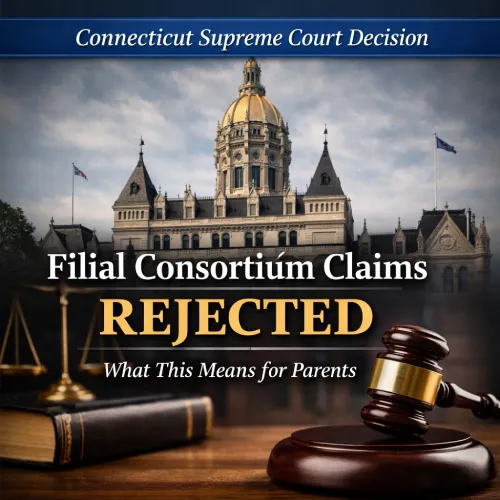
Filial consortium, simply put, is the legal right of a parent to the love, companionship, and comfort of their child, after a personal injury action. It is a type of non-economic damages often sought in personal injury or wrongful death lawsuits when a child is severely injured or killed, compensating parents for the loss of that relationship.
The Connecticut Supreme Court in L.L. et al. v. Newell Brands, Inc. et al. (SC2105), held that Connecticut state law does not recognize a parent’s claim for loss of filial consortium when a minor child suffers severe injuries due to a manufacturer’s and seller’s selling of a defective car seat and the stove, which caused the carseat to catch fire. The decision arose from a certified question submitted by the United States District Court for the District of Connecticut.
While Connecticut law permits claims for loss of spousal and parental consortium, the Court found that the underlying rationale for those claims, namely mutual dependence between spouses and a child’s reliance on their parents, did not extend to a parent’s loss of a child’s companionship. Instead, the Court limited the damages experienced by a parent in such circumstances to a claim for emotional distress rather than loss of consortium.
Facts:
Mary Lapointe placed her infant daughter, L.L., in a Graco car seat on the kitchen counter next to an electric stove and left the room. During her absence, the car seat caught fire. L.L.’s aunt, Kayleigh Lapointe, discovered the fire and rescued the child, but L.L. suffered severe burns and injuries across her entire body.
Mary, Kayleigh, Justin (L.L.’s father), and L.L. through Justin as her next of friend, filed suit in federal district court against multiple defendants, including Newell Brands, Inc., the manufacturer of the car seat; Target Stores, Inc., the retailer; Haier U.S. Appliance Solutions, Inc., the distributor of the electric stove; and General Electric Company. The plaintiffs alleged violations of the Connecticut Product Liability Act, but the district court dismissed those
Result:
The Supreme Court looked to Connecticut cases and those of other jurisdictions, but the Court declined to extend loss of consortium to filial claims.